Fernanda Navarro, Tradução Técnica e Juramentada
-
The People’s Word of 2018
About Words – Cambridge Dictionary blog
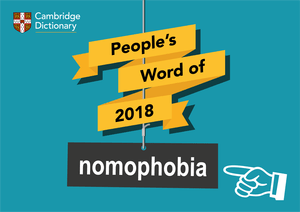 From New York to London to Tokyo, fans of the online Cambridge Dictionary have been voting for the word that they believe best sums up the year 2018. Our editors chose a shortlist of four words from this year’s new additions by looking at which ones were most popular and most relevant to 2018, and then asked you – our blog readers and social media followers – to vote.
The votes have now been counted and the People’s Word of 2018 has been decided. The word that received the most votes is:
nomophobianoun [U]
fear or worry at the idea of being without your mobile phone or unable to use it
The Cambridge Dictionary is one of the most popular online dictionaries in the world, and you, our users, are part of a very smart and enthusiastic global community using our free resources. So we were eager to give…
Ver o post original 281 mais palavras
-
You look a million dollars! (Describing appearances)
About Words – Cambridge Dictionary blog
Describing other people’s appearances is something most of us do now and then. We might do it in order to ask who someone is: ‘Who was the very smart guy in the blue suit?’ Sometimes we describe how other people look simply because we find it interesting: ‘Sophie always looks so elegant – not a hair out of place!’ If you’d like to expand your vocabulary for describing how people look, read on!
Ver o post original 461 mais palavras
-

The new IATE has landed: interview with Paula Zorrilla, coordinator of the project
The new IATE is almost here! This is why we wanted to present you some key ideas about what you can expect from the new IATE. We had the pleasure of interviewing Paula Zorrilla, project coordinator of IATE who gave us some technical and practical trails. Ready to discover them all?

You will find the Spanish version of the interview after the English one.
Ver o post original 3.765 mais palavras
-
30 Words Invented by Shakespeare
William Shakespeare (1564-1616), considered the greatest writer in the English language, used more than 24,000 words in his writings, more than any other author. Of those words, more than 1,700 were first used by him, as far we can tell. He may have made up many of them himself.
How can you possibly understand someone who keeps making up new words? Because Shakespeare made up his new words from old, familiar words: nouns into verbs, verbs into adverbs, adverbs into nouns. He added new prefixes and suffixes to existing words. For example, gloom was already a noun that meant ‘darkness’ and even a verb, but Shakespeare turned it into a adjective, as in ‘the ruthless, vast and gloomy woods’ in Titus Andronicus.
Renaissance writers, trying to express classical ideas for the first time in English, often borrowed words from the classical languages of Greek and Latin, and William Shakespeare was no exception. Also, in Shakespeare’s day, the rules of English grammar were not yet formalized, so he was freer to invent his own.
After more than 400 years of changes in the English language, Shakespeare is still beloved and still understood. Because of his knowledge of essential language, we still know what the Princess means in Loves Labours Lost when she says (archaically) “Prepare; I will away tonight,” even though she leaves out the verb “go.”
Here are 30 of the words invented by William Shakespeare, as compiled by my colleague Maeve in her article Shakespeare’s Vocabulary, each one demonstrated in a sentence from one of his plays:
1. accommodation: adjustment, adaptation, compromise
Thou art not noble; For all the accommodations that thou bear’st Are nursed by baseness. – Measure for Measure2. agile: able to move quickly or easily
His agile arm beats down their fatal points. – Romeo and Juliet3. allurement: Attractiveness, appeal, enticement.
That is an advertisement to a proper maid in Florence, one Diana, to take heed of the allurement of one Count Rousillon – All’s Well That Ends Well4. antipathy: dislike, hatred
No contraries hold more antipathy Than I and such a knave. – King Lear5. catastrophe: disaster, the dramatic event that begins the resolution of the story
And pat! he comes, like the catastrophe of the old comedy. – King Lear6. critical: inclined to criticize, extremely important
O gentle lady, do not put me to’t; For I am nothing, if not critical. – Othello7. demonstrate: show, display, present
And this may help to thicken other proofs That do demonstrate thinly. – Othello8. dexterously: skillfully, with precision.
Dexterously, good madonna. – Twelfth Night9. dire: dreadful, dismal, portentous
Hapless Aegeon, whom the fates have mark’d To bear the extremity of dire mishap! – Comedy of Errors10. dislocate: to put out of place
They are apt enough to dislocate and tear Thy flesh and bones. – King Lear11. emphasis: Special weight, attention, forcefulness or prominence given to something
Be choked with such another emphasis! Say, the brave Antony. – Antony and Cleopatra12. eyeballs: the eyes
‘Tis not your inky brows, your black silk hair, Your bugle eyeballs, nor your cheek of cream, – As You Like It13. emulate: imitate, copy
I see how thine eye would emulate the diamond: – Merry Wives of Windsor14. exist: to be, to have reality
By all the operation of the orbs From whom we do exist and cease to be; – King Lear15. extract: draw out, remove, withdraw,
May it be possible, that foreign hire Could out of thee extract one spark of evil That might annoy my finger? – Henry V16. frugal: thrifty, cheap, economical
I was then frugal of my mirth: Heaven forgive me! – Merry Wives of Windsor17. hereditary: inherited, passed on from parents
Hereditary, rather than purchased; what he cannot change, than what he chooses. – Antony and Cleopatra18. horrid: terrible, horrible
He would drown the stage with tears And cleave the general ear with horrid speech; – Hamlet19. impertinent: insolent, ill-mannered, irrelevant
In very brief, the suit is impertinent to myself, – Tempest20. jovial: jolly, cheerful, merry
Be bright and jovial among your guests to-night. – Macbeth21. meditate: think, contemplate, study
I will meditate the while upon some horrid message for a challenge. – Twelfth Night22. modest: moderate, slight, humble,
Do not cry havoc, where you should but hunt With modest warrant. Coriolanus23. mutiny: tumult, strife, rebellion against a legal authority, especially at sea
Good friends, sweet friends, let me not stir you up To such a sudden flood of mutiny. – Julius Caesar24. obscene: indecent, offensive, repulsive
O, forfend it, God, That in a Christian climate souls refined Should show so heinous, black, obscene a deed! – Richard II25. pedant: a schoolmaster, someone who shows off his knowledge by using big words
Most villanously; like a pedant that keeps a school i’ the church. – Twelfth Night26. pell-mell: hasty, uncontrolled, confused
Advance your standards, and upon them, lords; Pell-mell, down with them! – Love’s Labour’s Lost27. premeditated: deliberate, planned in advance
Some peradventure have on them the guilt of premeditated and contrived murder; – Henry V28. reliance: trust, dependence
And my reliances on his fracted dates Have smit my credit: – Timon of Athens29. submerged: underwater, below the surface, hidden
So half my Egypt were submerged and made A cistern for scaled snakes! – Antony and Cleopatra30. vast: Very large or wide
The sun’s a thief, and with his great attraction Robs the vast sea: – Timon of AthensCould we make up new words too, and still be understood? In imitation of Shakespeare, I tried making up a couple – do you understand me?
The anticlean toddler boy.
Though you lamb yourself after your violence, quoth Sherlock, yet before judge and jury I will unlamb you.
Shakespeare invented many words that might surprise you. In Shakespeare’s day, friend was already a noun, but Shakespeare turned it into a verb. Befriend is a more standard verb that expresses the same thing, but a newly-coined word has extra power and surprise – but unless you do it discreetly, you’ll sound like e e cummings or James Joyce. Shakespeare also used the word unfriended, centuries before Mark Zuckerberg. The word swagger, popular with rap musicians, was first used in Henry V and A Midsummer Night’s Dream, though Shakespeare didn’t invent the word swag.
Posted by DailyWritingTips on Oct. 31, 2018
-
Dia D – Dia de Drummond
José
E agora, José?
A festa acabou,
a luz apagou,
o povo sumiu,
a noite esfriou,
e agora, José?
e agora, você?
você que é sem nome,
que zomba dos outros,
você que faz versos,
que ama, protesta?
e agora, José?Está sem mulher,
está sem discurso,
está sem carinho,
já não pode beber,
já não pode fumar,
cuspir já não pode,
a noite esfriou,
o dia não veio,
o bonde não veio,
o riso não veio,
não veio a utopia
e tudo acabou
e tudo fugiu
e tudo mofou,
e agora, José?E agora, José?
Sua doce palavra,
seu instante de febre,
sua gula e jejum,
sua biblioteca,
sua lavra de ouro,
seu terno de vidro,
sua incoerência,
seu ódio — e agora?Com a chave na mão
quer abrir a porta,
não existe porta;
quer morrer no mar,
mas o mar secou;
quer ir para Minas,
Minas não há mais.
José, e agora?Se você gritasse,
se você gemesse,
se você tocasse
a valsa vienense,
se você dormisse,
se você cansasse,
se você morresse…
Mas você não morre,
você é duro, José!Sozinho no escuro
qual bicho-do-mato,
sem teogonia,
sem parede nua
para se encostar,
sem cavalo preto
que fuja a galope,
você marcha, José!
José, para onde?Carlos Drummond de Andrade (31 de agosto de 1902 – 17 de agosto de 1987)
-
Making an effort and telling a joke: avoiding common errors with collocations
About Words – Cambridge Dictionary blog
 NickyLloyd/E+
 by Liz Walter
Collocation, or the way we put words together, is a very important part of English. In this post, I am going to look at some of the most common mistakes learners make with verb + noun collocations. If you make these errors, people will still understand you, but your English will not sound natural and you will lose marks in exams.
Ver o post original 370 mais palavras
-
On the spur of the moment (Words and phrases to describe sudden actions)
 Luis Alvarez / DigitalVision / Getty Images
 Much of what we do each day is planned or expected but not everything. Sometimes, for whatever reason, we suddenly do things that we are not expecting to do or have not prepared for. This week, we’re looking at the language that we use to express this.
Let’s start with a very useful adjective: spontaneous. A spontaneous action is sudden and done as a natural response to what is happening at the time: The silence was broken by spontaneous applause. / When she got up to leave, everyone applauded spontaneously. The noun from ‘spontaneous’ is spontaneity: We all need a little spontaneity in our lives.
Ver o post original 306 mais palavras

 by
by 


 TRADUÇÃO TÉCNICA E JURAMENTADA